29 February 2008

Words Words Words (day 5)


Not only did I manage a whopping 2,711 words today, I baked banana bread for the neighbors in my break. There is something strangely energizing about looming deadlines. My document came in at just over 10,000 words, exactly 30 pages (whew), and it's done for now. There will be much revising, throwing out, despairing, and whatnot later, but for now, I'm celebrating. My version of that will be heading to the public library to get two books I'm totally interested in but would never buy. Perfect. Thanks for your support!

The Joy of Sharing Books


The only thing better than reading book is suggesting books to other people, and what a reward when they take your advice. A couple of weeks ago, I recommended one of my big childhood favorites, Mr. Popper's Penguins to Natasha over at Maw Books. She's just posted her thoughts if you're curious. I may have to read it again myself...

28 February 2008

Words Words Words (day 4)

Today's count: 2,155. This one's worth a little victory dance. Thanks for the supportive comments, it really helps counteract the oppressiveness of writing at home. With any luck, tomorrow will be the end of this particular sprint. I'll keep my fingers (and toes) crossed. Do you think it will slow down my typing?

For those of you who are dead bored by reading word counts (I mean seriously, how dull can a blog become?!), I promise a book review when this is over. Reading fiction is a major element of my personal procrastination technique (PPT). February has led to eight new editions to my reading list. The most recent was Zadie Smith's On Beauty. Here's a well written Salon review to whet your appetite. Stay tuned!

Words Words Words (day 3)

Only managed 1,435 for day 3. Quite disappointing, actually. It will be a challenge to stay motivated and working for day 4. Hope it goes better. My total word count is now 5,431.

26 February 2008

Words Words Words (day 2)

I managed to knock out a whopping 2,386 words today. This is not my normal rate of writing. Back in my MA thesis days, the goal for a writing day was 1,000 words and most of those were bound for deletion. However, this time around, I decided to work first with a detailed outline. This little document (well, big) is walking me through what I need to do and leaving me some space to interject new ideas as I work along. Most importantly, I never sit down wondering what to write next. The outline shows me where my argument or discussion has to go. Now, whether this will be successful or not is up to the experts, but so far it's feeling good.

Someone asked me yesterday how many words I need... around 10,000 to call this chapter good. So, probably 12,000 and then editing, if there's time! But on the positive side, I'm 20% there with 40% of my days gone. Wait a minute... there might be something faulty with that math...

Labels here to stay!


It turns out these labels are a pretty big deal. Latest news is that the Dutch parliament says that the term allochtoon is here to stay. In fact, it's "indispensable." Without it, how can they deal with allochtoon problems? Oh, the madness. As the article says, they're talking about immigration and integration. So, what about going crazy and using a word like, oh, say, perhaps, "immigrant?"

25 February 2008

Words Words Words (day 1)

I've got a deadline this week and am writing up a storm. It's encouraging to keep a word count and share it. So today, mark me down for 1,061. Whew! Let's see what I can do tomorrow!

Do labels matter?


Imagine my surprise and delight when I read a headline indicating that Justice Minister Hirsch Ballin wants to stop usage of the word allochtoon. That can only be matched by my amusement and dismay when the next set of headlines indicated that the VVD (Liberal Party) and PVV (Party for Freedom) are "annoyed" at Ballin's request. Apparently, they want him to stop "whining" because stick and stones may break your bones, but words can never hurt you. Let's call that a summary of their argument. Given that you may not share my obsession with Dutch immigration politics, allow me to explain a couple things.

The VVD is generally known in English as the Liberal Party, although their website indicates that they are the "People's Party for Freedom and Democracy)." They take a conservative stance on immigration. Former party member Rita Verdonk was the Minister for Immigration and Integration from 2003 until 2007. Other well known former party members include Ayaan Hirsi Ali (see my posts here and here) and Geert Wilders. All three have left the party. All three take even more conservative stances on immigration than VVD.

The PVV (information in English here) or Party for Freedom is Geert Wilders' new party. Formerly known as the Group Wilders, the party won nine seats in parliament in 2006, its first elections. The PVV's main position is that Muslims do not belong in the Netherlands. To that end, the party has made various proposals over the last year, including banning the Koran. They are often in the news thanks to Wilders' patent provocative style (and possibly also his hair). His latest plan is to release a short film about the Koran. No word yet on who will be broadcasting the film.

All of which allows me to get back to this allochtoon word. Basically, an allochtoon is someone who is not of Dutch decent, meaning not of Dutch blood. Citizenship is not the question, rather heritage. The British, French, Germans, Chinese, Americans, Turks, Belgians, Indians, you name it, if you are not of Dutch blood, you are an allochtoon. At least, that's the official definition. In practice, the word is used to refer to non-whites. It's a linguistic form of discrimination. All immigrants are allochtoon, even after they have citizenship. Furthermore, there are divisions into first and second generation allochtonen. It's a complex system and one that could stand with revising. I'm terribly disappointed to see that a serious comment has been reduced to petty "whining" by the PVV and VVD's responses. However, it does give you an idea of the level of the Dutch immigration debate these days.

I'll close with an adapted excerpt from my MA thesis - just because it goes into more detail about the terminology, in case you're interested.


Historian Ian Buruma describes the word “allochtoon” as “an ugly, and relatively new, bureaucratic term for people of alien, but more specifially non-European, origin” (Buruma 149). The Dutch-English van Dale dictionary translates “allochtoon” as either “immigrant” or “foreigner.” However, the Dutch translation of “immigrant” is “immigrant” and the Dutch word for “foreigner” is “buitenlander” or “vreemdeling.” There is no accurate translation for “allochtoon” in English. The opposite of allochtoon is autochtoon, which refers to what would be considered “real” Dutch, people born in the Netherlands to two Dutch parents. The word autochtoon should not be confused with citizenship because a Dutch citizen can be either allochtoon or autochtoon. In addition to being a specifically Dutch concept, allochtoon is a highly politicized term that perpetuates colonial-style classifications.

The Centraal Bureau voor de Statistiek (CBS), Central Statistics Office, has developed a statistical definition for allochtoon. It has also devised several ways to differentiate between allochtoon groups. These definitions determine how the word allochtoon is used in official documents like the Dutch integration law. According to the CBS, an allochtoon is a person living in the Netherlands who has one or more parents who were born in a foreign country (Garssen, Nicolaas and Sprangers 96). Allochtonen can be categorized by a combination of two characteristics; country of origin and generation. First-generation allochtonen were born in a foreign country, their country of origin. Second-generation allochtonen have at least one parent who was born in a foreign country. For second-generation allochtonen, their country of origin is their mother’s birth country, unless she was born in the Netherlands, in which case the child’s country of origin is the father’s birth country. Like the colonial hierarchy used in the Dutch East Indies, this method looks first to mothers to determine the country of origin.

All allochtonen are also classified as either “western” or “non-western” based on their country of origin. Western allochtonen are those whose country of origin is in Europe, North America, Oceania, or is either Indonesia or Japan. Non-western allochtonen are those whose country of origin is in Africa, Latin America, Asia, or is Turkey. Indonesia and Japan are excluded from the category “non-western” because of their social and economic status (Garssen, Nicolaas and Sprangers 96). Indonesia has old colonial ties to the Netherlands and most Japanese immigrants are here temporarily for work. These categories are used for statistical purposes. However, the way they are defined, especially the fact that Indonesia and Japan are considered western and the ambiguity that makes North America western but Latin America non-western, leaving Mexico and Central America in-between, demonstrates that these categories are not actually geographic. On the contrary, this system of classification recalls Anne Stoler’s comments about racism based on external features and birthplace mistakenly taken as indicators of personal and cultural traits (Stoler 133-34). This system tends to emphasize difference over similarity and can contribute to statistical reporting that inflates the number of immigrants in the Netherlands. The intensive categorization of allochtonen reflects an affinity with the differentiation between colonists and inlanders used by the Dutch in the Dutch East Indies.


Buruma, Ian. Murder in Amsterdam: The Death of Theo Van Gogh and the Limits of Tolerance. New York: The Penguin Press, 2006.

Garssen, Joop, Han Nicolaas, and Arno Sprangers. Demographie Van De Allochtonen in Nederland: Centraal Bureau voor de Statistik, 2005.

Stoler, Ann Laura. Race and the Education of Desire. Durham and London: Duke University Press, 1995.


24 February 2008

House Weekend


This is our house. It's an old house, built just before 1910. We've been living here since May 2006. It's home now, and we enjoy it.

Unfortunately, any house needs work. This is especially true if you move in with almost exclusively borrowed/second hand/cast off furniture that you've bought in the "If we don't have a couch we'll have to sit on the floor" mode of shopping and would like to make it homey and nice. We've made good progress, but it's tough to find the time for planning and little projects that make a big difference. About a year ago, we introduced the House Weekend. We pick a weekend (usually three or four over as many months) and devote it to working on the house. We'll allow ourselves one evening out with friends, but otherwise turn down all invitations and make no plans to do anything other than work on the house. It sounds kind of boring, but it works.

Since it's been a while since we did any concentrated work on the house - something about getting married and a perfectly insane fall semester at work slowed us down - we started yesterday with a giant inventory. We walked through the house with a pad of paper and just wrote down everything we dream of doing in each room of the house. Now we've got a starting point for setting priorities and getting things done. Not such a bad system, really. Of course, my favorite was my comment about our kitchen. Everything goes at list writing time, so I said, "Rip it out and start over." I don't think that's going to make our final cut. I tried...

22 February 2008

Then again, maybe not...


Yesterday, the news reported that France will not pay for Hirsi Ali's protection outside of France, should she become a French citizen. According to the article, France only pays to protect its diplomats outside of the country. I commented on this story earlier this month, so it's rather interesting to see France's government's response to the intellectuals and politicians who first suggested that Hirsi Ali become a French citizen. One can only assume that French citizenship will become significantly less attractive to Hirsi Ali if it does not include the protection she needs.

Of course, in the way that all things come together or rather conspire to make me rethink positions, Vrij Nederland, a liberal weekly Dutch news magazine, featured an article about Hirsi Ali's protection problems this week. The gist of it is that authors and columnists in the Netherlands, whether they agreed with her or not, are calling on Prime Minister Jan Peter Balkenende to reverse the October 2007 parliamentary decision to not pay for Hirsi Ali's protection outside of the Netherlands. According them, regardless of what Hirsi Ali says, the Netherlands is duty bound to protect her right to freedom of speech.

This sets me thinking. Do I think that the Dutch government should pay for Ayaan Hirsi Ali's protection outside of the Netherlands? What about the freedom of speech? There are a couple of interesting facts to consider here. For example, Hirsi Ali is living outside of the Netherlands because she took a job in Washington D.C. She choose to leave the Netherlands, where she would be protected to work in the United States. And there is the fact that she left amidst some serious controversy with regards to her application for Dutch citizenship. I think these help explain a lack of public support in the Netherlands for her protection outside the country.

Then there's the freedom of speech question. I have to admit to having my doubts the past few years. Mainly because freedom of speech seems to be a sliding scale. Insult Muslims by offending one of the basic beliefs of their faith, like publishing Mohammed cartoons, and you're within your rights. When people then protest, and I'm not advocating death threats or threats of violence, but protest, they're criticized for opposing freedom of expression. What happened to their right to disagree? Freedom of speech seems to belong to the liberally provocative and, most importantly, to the secular. The example that particularly irritates me happened in the Netherlands a few years ago. After Theo van Gogh's murder, there was an outcry about his right to the freedom of expression, mainly in reference to the film Submission, which was critical of Islam. A few months later a fire at the illegal immigrant detention center at Schiphol airport resulted in the deaths of 11 detainees. The sitting Minister for Immigration and Integration, Rita Verdonk, was held responsible for the incident. When protesters hung sheets that read "Verdonk Murderer" from windows, the sheets were removed by authorities.

All this leaves me wondering, if we can agree that the freedom of speech is important, can we agree on who it applies to? At this point, it seems like freedom of speech has come to be understood as a freedom to provoke unpopular positions. And isn't there a responsibility that comes with having the freedom of speech?

20 February 2008

Conversion Complete


Doing a little bit to be more green is important. Well, I'm sure there are plenty of arguments to say that one person doing a little bit doesn't make a difference at all, but I have resolved to ignore those and keep trying my little bits. Besides, there are some awfully compelling stories out there about one person making a big difference in the environmental movement. In this case, a guy living in New York City who decided to try to live a year with no impact. In his words, "In other words, no trash, no carbon emissions, no toxins in the water, no elevators, no subway, no products in packaging, no plastics, no air conditioning, no TV, no toilets…" His experiment has concluded successfully, but it's still interesting to read old posts and follow his re-entry experiences.

My little bit is a buying green cleaning products for our home. When we first arrived in the Netherlands, I had no idea where to find these products and in the rush to get settled in, bought what I could find in the supermarket. Today, I have an idea (they're called naturwinkels) and a source. I've been replacing our cleaning products with Ecover brand products as we ran out. It's not nearly as good as making our own cleansers, but it's a start. My personal milestone was replacing our allesreiniger (literally "everything cleaner") with green stuff. Of course, just as I thought I was doing a good thing, I discovered that Ecover has fairly recently been involved in a scandal over their claim to not test on animals. The fun never stops.

What do you think, do little changes matter? Have you made any?

19 February 2008

Magnum Exhibit


I want to see this exhibit. It's a 60 years of Magnum photos retrospective showing at the Stedelijk Museum (modern art) in Amsterdam. My first encounter with Magnum, a photographic cooperative with a stunning website, was about five years ago when I bought their book of soccer photography. It was the perfect gift from an aesthetically inclined girl to a soccer obsessed boy. The images caught my attention because they captured emotions and spaces in a truly beautiful way. To tell the truth, it changed the way I thought about soccer; less as a boys game and more as something that brought people together in all kinds of places. My second encounter was going to World Press Photo exhibits and realizing that quite a few prize winners were Magnum photographers. So, I'm looking forward to seeing the exhibit. Just need to pick a day - and maybe find a companion...

18 February 2008

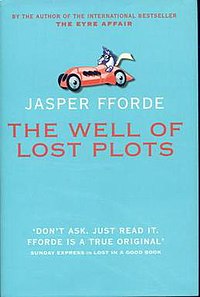
The Well of Lost Plots


I read Jasper Fforde's The Well of Lost Plots. I was lucky enough to find a Fforde book in my local thrift shop on Friday when specifically looking for one. After posting a list of books I read last year, I got a sudden hankering to read more books like The Eyre Affair (here's a review). Fforde's books are best described as Hitchhiker's Guide's to Bookworld. They are full of imaginative trips into books in which well-known (and sometimes obscure) characters come to life as themselves and as the actors who play the characters. Fforde manages to pack each book with references to mostly classic English literature and gets you thinking that it might not be such a bad idea to read some Dickens next. Summarizing the plot is a bit difficult, but I'll give it a shot.

Main character Thursday Next is taking a break by going on the Character Exchange Program. She'll spend a year living inside a relatively obscure book and the character she's replacing will get to take some time off. When she's not filling in for her character and trying to improve her exchange program book, she's training to join Jurisfiction. Jurisfiction meets in Sense and Sensibility and is charged with maintaining the structural (plot) integrity of books in the Bookwell, a place where books in the making are stored. Murder, intrigue, and a Bookworld power struggle ensue. If your imagination can keep up, you're in for a wonderful ride with this story. Best of all, this book comes with a special features section! I recommend it for an entertaining read.

15 February 2008

Reading Lists


I was reading my New Yorker again and ran across an article about Art Garfunkel. Remember him? The other half of Simon and. It turns out that Mr. Garfunkel has been keeping a list of every book he's read since June 1968. That's 40 years worth of reading, over 1,000 books, and an average of just over two books a month. The list is not wimpy as it seems Mr. Garfunkel has a taste for classics, non-fiction, and good literature. Always excellent to see what other people read and, if you're Notablogger, grin a little to yourself.

I've kept a list of every book I've read since January 1997. Among other things, it's nice to know that other people share my little penchant for keeping track of things. When I finish reading a book, I make a note in the back of my journal and when I finish the journal, I copy over the list into a book journal. It's just dates, authors, and titles, but I quite enjoy giving it a glance once in a while. Last year I realized it had been ten years of list keeping and did some math that I updated this morning.

Between January 1997 and December 2007, I read 486 books. That's around three and a half books a month. The list is less impressive than Mr. Garfunkel's, but he started his list at age 29. Having only (relatively) recently passed that year, I guess it's time to start getting serious. In the meantime, here's my list for 2007, with a star behind those titles I found especially good for whatever reason. (Kluun's Komt een vrouw bij de dokter is available in English now!)

January 2007

Pearl S. Buck, The Good Earth
J.K. Rowling, Harry Potter and the Half-Blood Prince
John Grisham, The Broker
Ian Buruma, Death in Amsterdam

February 2007

Salman Rushdie, Shalimar the Clown
Tibor Fischer, Under the Frog
Frederick Forsyth, Icon
David Maine, The Flood
Frederick Forsyth, The Afghan

March 2007
Doris Lessing, The Golden Notebook*
Carlos Ruiz Zafón, The Shadow of the Wind
Thronton Wilder, The Bridge of San Luis Rey*

April 2007

Ruth Prawer Jhabyala, The Householder
A.S. Byatt, The Game
Jeanette Winterson, Gut Symmetries
Kluun, Komt een vrouw bij de dokter*

May 2007
Pamela Duncan, Plant Life
Daphne du Maurier, Rebecca*
Penelope Lively, Moon Tiger
Ha Jin, Waiting
William Faulkner, As I Lay Dying
Marisha Pessl, Special Topics in Calamity Physics

June 2007

Margaret Atwood, The Blind Assassin
Frederick Forsyth, The Odessa File
George MacDonald Fraser, Flashman

July 2007

John Irving, A Son of the Circus
John Updike, Gertrude and Claudius
Marjane Satrapi, Persepolis I*
Ian McEwan, Saturday
Ann Patchett, Bell Canto*

August 2007
Matthew Pearl, The Dante Club
Jasper Fforde, The Eyre Affair*
Khalid Hosseini, A Thousand Splendid Suns*
Ralph Ellison, Invisible Man*

September 2007
J.K. Rowling, Harry Potter and the Deathly Hallows
Lee Smith, Oral History
Marina Lewycka, A Short History of Tractors in Ukrainian
Gabriel Brownstein, The Curious Case of Benjamin Button, Apt. 3W
Howard Zinn, A People’s History of the United States, 1492 – Present*

October 2007

Penelope Lively, The Photograph
Zoë Heller, Notes on a Scandal*
Kate Mosse, Labyrinth
Peter Elbling, The Food Taster*
Robert Ludum, The Prometheus Deception
David Baldacci, The Camel Club

November 2007

Anita Shreve, The Last Time They Met
Ian McEwan, Amsteradm*
Marjane Satrapi, Persepolis II*
J.K. Rowling, Harry Potter and the Half-Blood Prince
Khalid Hosseini, The Kite Runner

December 2007
Jed Rubenfeld, The Interpretation of a Murder*
Steven Pinker, The Language Instinct*
Charlotte Brontë, Jane Eyre*

13 February 2008

Leaf


I'm listening to Leaf's new album today. They're a local band who apparently taped this first album right near here at Zandvoort. The album, Life's a Beach, includes the single Wonderwoman (watch the video!) and is kinda funky and fun. The video's cute with shots in what must be Amsterdam's Vondelpark and references to good old Dutch apple cake! It reminds me of other music - Virginia Coalition's Townburg album as well as Hipbone. Both are bands I got to hear live first and then enjoy on CD later. I'm even less of a music person than a movie person, so my collection and knowledge are a bit grim. If you know of any similar music to this, please let me know!

12 February 2008

Don't Let's go to the Dogs Tonight


I just finished reading Don't Let's go to the Dogs Tonight by Alexandra Fuller. It's a memoir of her childhood in Africa. I have to admit to having mixed feelings about it, especially Alexandra herself. She seems quite self-involved and it's interesting to see how little she develops the characterizations of the rest of her family. Sometimes it's as if they're really not interesting to her at all, except how her mother's alcoholism and depression made her life difficult or how she was jealous of the attention her sister was getting from boys.

On the other hand, her writing really evokes a time and a place and an attitude that is quite unique. Imagine being a white African, which is essentially what she is, who she is. We (I) have such difficulty thinking about African as anything other than black, that it becomes interesting to read another side of the story. The details of daily life both on the various farms and during war times, are quite fascinating. Her sense of ownership and superiority are so palpable as to seem natural. Yet the fact is that she was living a colonial legacy. Later in her book, she seems to become more aware of that fact, but her sense of entitlement seems to remain.

It was an interesting read, no doubt. Unfortunately, I haven't read much African literature (must change that). However, I would recommend either of Algerian Frantz Fanon's books, Black Skin White Masks or The Wretched of the Earth for a black African perspective on colonialism and truly spell-binding prose. I know I've also read Nigerian Chinua Achebe's Things Fall Apart, which is a classic. Unfortunately, I can't recall what it's about. Finally, for another white African story, there's the classic Out of Africa by Karen Blixen (alias Isak Dinesen. Both the film (starring Meryl Streep and Robert Redford) and the book (including illustrated tale of the bird (stork?) that I love) are worth the time.

Going French


I was quite surprised to see in the papers yesterday that Ayaan Hirsi Ali, Holland's most and least favorite Somali immigrant and former parliamentarian, is considering becoming French. Hirsi Ali is an outspoken critic of Islam and has been living under protection for several years. She has been the target of numerous death threats, especially after the killing of Theo van Gogh in relation to the film "Submission," a project that he collaborated on with Hirsi Ali. In 2006, after an unrelated crisis in which she nearly lost her Dutch citizenship, she moved to Washington D.C. to work for the American Enterprise Institute. The Netherlands agreed to pay for her protection for one year, and when that year ran out last fall, they stopped paying. As a result, Hirsi Ali has had to seek private funding for her personal protection. Now, a group of intellectuals and politicians in France is petitioning for her to receive French citizenship so France can pay for her protection.

Do I think that Hirsi Ali has a right to physical protection? I wouldn't claim to know enough about her situation to answer that question, but my tentative answer is "probably." Yet still, this new development irritates me. For one thing, there was a lively debate in The Netherlands last fall about loyalty. The issue arose because a number of newly elected parliamentarians had dual nationality. There were questions about their ability to perform their state duties as individuals with potentially split loyalties. Will this question, or a version of it seeing as how she's no longer in parliament, be raised again in light of Hirsi Ali's eagerness to switch nationalities?

Another thing that bothers me is the media's insistence on comparing Hirsi Ali with Salman Rushdie. There is a difference between receiving numerous personal threats and having the orthodox Islamic leadership issue a fatwa against you. With her two books, The Caged Virgin and Infidel, Hirsi Ali has surely angered many people, but her safety situation has not escalated the way that Rushdie's did. Remember that for many years, Rushdie never appeared in public.

I have intentionally left out any commentary about Hirsi Ali's anti-Muslim position here. Whether I agree with her or not, I can agree that she has a right to speak out. But something about the easy adoption of any convenient nationality sits wrong with me. Maybe it shouldn't. Maybe we should all be able to switch nationalities as easily as t-shirts and passports shouldn't matter. What do you think?

10 February 2008

Kid Movies

Yesterday I caught the first hour of the movie Splash on the television. What a hoot. I still giggle when the park ranger first sees Darryl Hannah naked at the Statue of Liberty... "The Statue is a gift from French citizens and has come to symbolize hope for naked women everywhere... BOCCE BALLS." It got me thinking about all those films I remember from being a kid which might not be good at all, but I miss them. There was Big, another Tom Hanks film, and Indiana Jones and the Temple of Doom, which my sister could recite every line of. We also both knew most of Spaceballs. Then there's Gremlins and The Goonies, with the funny Japanese kid and his super gadget trench coat. And of course The Princess Bride, "As you wish," and Willow, "You stupid daikini!" and Val Kilmer in bad drag.

Of course, the best part of this list is that I was no more than 12 years old when these movies came out and cannot be held responsible for any lapses in taste! What movies do you remember from being a kid?

09 February 2008

Amsterdam Bijlmer


View Larger Map

I work in Amsterdam Bijlmer. That's pronounced BILE-mer. It's in south eastern Amsterdam, on the far side of the city if you're coming from Haarlem. The Bijlmer was built up in the 1960s with public housing to accommodate Amsterdam's growing immigrant population. Most people who come to Amsterdam only see the beautiful center and every popular Red Light District. It can be hard to believe that there is an entire section of the city built up of apartment blocks. Recently, a local artist has made the Bijlmer the subject of a year-long documentary project. Her blog in Dutch, but the images she creates and records are quite interesting.

If you are from the Netherlands, you probably know about the Bijlmer because of the Bijlmer Ramp or Biljmer disaster. On October 4, 1992, an El-Al cargo jet crashed into one of the apartment buildings, destroying 266 apartments and claiming 43 lives. The official death toll remains contested because of the number of illegal residents living in the apartments. No one will ever know how many of them perished in the crash. The Amsterdam City Archives has a film clip showing the fire, resulting damage, and visits from Queen Beatrix and then Prime Minister Ruud Lubbers.

Today, the Bijlmer is undergoing some changes. They are nearly finished with the new train station. Although its connections to Amsterdam Central are a bit weak at only twice an hour, it is quite a sight. Have a look at some pictures by a train station fan. The train station will make it easier to attend their annual festival, Kwakoe. It's the "biggest multicultural festival in the Netherlands," held every July and August. For now, though, I'm guessing that the reason most people choose to go to the Bijlmer is to attend a concert of Ajax football game at the ArenA.

Me, I'll just keep telling people about my local favorite Surinamese sandwich shop. Nothing like the multicultural center of a city for good food!

07 February 2008

Spread the Wealth


Well, yesterday I had a go at self-promoting and what a great response! It seems only appropriate now to spread the wealth and send you (newly) faithful readers to check out a couple more sites and blogs that belong to folks I know. Now, there's my challenge buddy who is also trying to blog daily, appropriately called My Year Online. Then there are a couple of interesting interactive sites with maps about breweries and bad intersections. Informed Public is a team blog that looks at media and politics, which will be interesting as the primaries pick up pace. There's also a nice personal blog about life in the big city... London! If you really like stories of foreigners in foreign countries and read German, this one is for you!

Now, when I first discovered blog-land, there were to serious challenges. The first was finding the time to read, explore, and enjoy all these blogs in between working and other "real life" activities. The other way finding a way to keep up with blogs. After all, checking blogs that haven't been updated yet is like opening your email time after time and finding no new mail. Then I discovered Google Reader. There's some kind of technical name for it (RSS reader, I think), but basically it checks your blogs for you and shows you all the posts in one place! You can search for blogs in areas you're interested or enter URLs to subscribe to them.

So, I wish you happy reading and discovering!

06 February 2008

What is the What


Not to jump on the bandwagon or anything, but this morning I finished reading Dave Eggers' What is the What. It was fantastic. You can find reviews and information here. The book tells the story of one of Sudan's Lost Boys. The Lost Boys are boys who walked across southern Sudan to Ethiopia only to be chased on to the Kakuma refugee camp in Kenya. Eggers writes a compelling tale in which the details are so shocking that it is difficult to believe they're true. Sometimes I had to remind myself that although the book is a work of fiction, it is a fictionalized memoir based on reality. You should read this book.

In case the book doesn't seem real enough, there are plenty of sources on the old internet to help you do a little bit of research. Valentino, the main character, has his own foundation and website. Where you can read about his efforts to help rebuild his hometown, Mirial Bai. There is also an award winning documentary about the Lost Boys as well as a documentary photography project.

All of this, of course, leaves me with questions. What's a person to do about these types of stories? I'm capable of reading the novel and feeling shocked, ashamed, and angry about the tale it tells. A story like this is clearly a call to action. In the preface, Valentino writes,

Even when my hours were darkest, I believed that some day I could share my experiences with readers, so as to prevent the same horrors from repeating themselves.

He did his share and his story has been published to great acclaim. But how can storytelling prevent a the same thing from happening again unless the reader takes some action in response to the story?

The first thought that occurs is a donation. But to whom do you give? Is your purpose to prevent the situations that create hundreds of thousands of refugees or to try to ensure that those refugees have an opportunity to rebuild their lives? Is political action a better route? But then what type of action can I take as an individual? Write a letter? Organize or attend a protest? Vote for a particular candidate? In other words, if you recognize that the world needs to change and you want to help change the world, it is a completely overwhelming thing to think about. Perhaps the best an individual can do is to choose a course of action and try to follow through. Maybe by telling the (very few) people who will read this post that they should read this book, I am helping. But that really isn't very convincing at all right now. What are your thoughts on the question(s)?

Related Posts Plugin for WordPress, Blogger...